
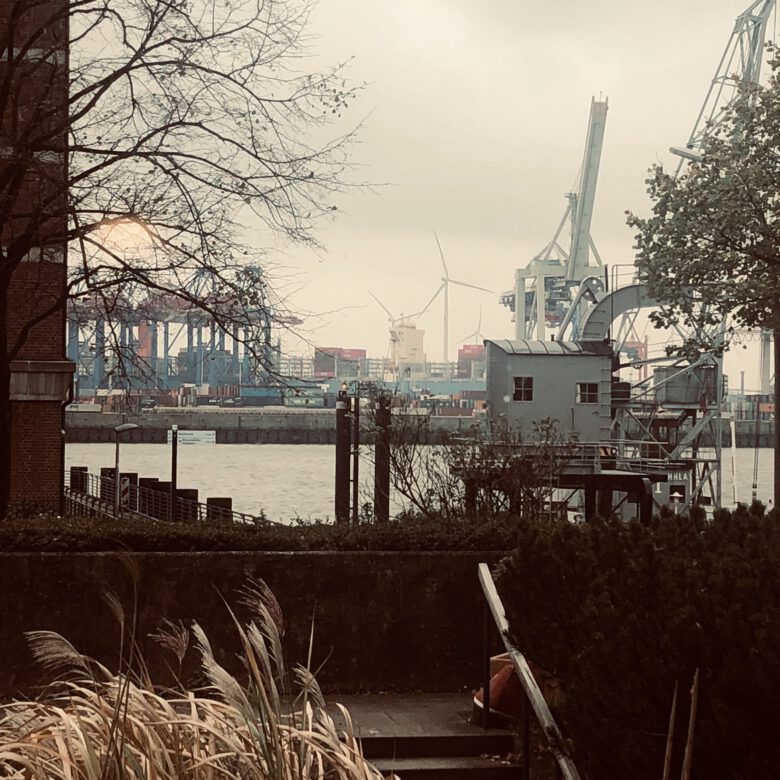
Hamburg-Neumühlen
In those days, I lived in a small apartment in Hamburg-Neumühlen, a breath away from the river. There was a window nook in the living room — a glass alcove overlooking the slow, tidal pulse of the Elbe. From that quiet corner, I watched the cargo ships glide past like silent beasts, heavy with stories from far coasts. The air always carried a scent of departure — metal, river salt, a hint of rust and longing. I didn’t know it yet, but that small nook of glass and river light would become the first altar of my becoming.
Life around me moved fast — city rhythms, deadlines, conversations made of surfaces. Yet each time I stepped into that little nook of stillness, something ancient stirred beneath my skin. A remembering. A whisper that spoke not in words but in pulse: south, south, south. Not as a destination — but as a texture, a different way of belonging to life. I wasn’t dreaming of escape. I was longing for a different pace of breath, a slower weave between body and earth.
Sometimes I would press my palm against the glass, as if I could feel the river’s heartbeat through it. The world on the other side felt wider, wilder — even in the grey months when the water was the colour of pewter and the sky hung low like a tired animal. Something in the Elbe carried the memory of elsewhere. Not in the way travel magazines spoke of destinations, but in the way ancient roads speak through dust. A quiet insistence: there are places where your bones will remember what the city made you forget.
Back then, I didn’t yet have language for belonging. I only had the ache.
Sometimes longing doesn’t begin as a vision. Sometimes it begins as a discomfort — a subtle misalignment between the body and the life it is living. I could feel it most clearly in the mornings, when the city rushed itself awake and I would stand barefoot in that window nook, watching the first ship move through the mist. The world expected speed, productivity, clarity of goals. But the river moved like an animal that refused to be hurried. It lingered, curled, breathed in tides. And something in me — tired of linear time — leaned toward that rhythm without understanding why.
It’s strange how a place can witness your becoming long before you claim it. That window nook, with its quiet light and river breath, held the first conversations between my longing and the world. I didn’t speak them out loud — but the river heard. I think now that longing is a form of prayer, even when we don’t know we are praying.
Years before I ever set foot among the olive trees that would one day hold my footsteps, there was Greece. Hydra, to be exact — a wild, stone-sculpted island where donkeys moved through narrow alleyways like ancient guardians. I remember standing before a house there — whitewashed, quiet, overlooking the sea — and something in me recognized it before my mind did. It wasn’t about the house itself, but about the life it hinted at. A life made of salt, slowness, hands stained with herbs and sun. A life that breathed differently.
Back in Neumühlen, I would hold that image like a small ember. Sometimes it came through photographs, sometimes through that book — “Life at the Beach” — a simple object, almost laughably casual. Yet it carried the scent of something my body already longed for: skin dried by wind, unhurried mornings, the permission to belong to a place without conquering it. I didn’t know then that these were fragments of a future life assembling themselves quietly in the corners of my days.
Hydra was never about relocation. It was a symbol, a threshold. An early pulse from the south. Even when I didn’t move there, even when life took me elsewhere, that house — that imagined life — had already carved a space inside me. A remembering of something older than plans: a desire to live close to the elements, to wake with the earth instead of the clock. Greece planted the first root of that desire. The river tended it.
There comes a moment — quiet, almost unremarkable — when longing stops being a distant ache and begins to take shape as direction. For me, it didn’t arrive with fireworks. It arrived in the way my body started to resist the pace of the life I was living. Meetings felt like confinement. Calendars like cages. Even joy wore a thin layer of exhaustion. It was as if my system knew before I did: this rhythm is not yours anymore.
The river, the window nook, the silent image of that house in Greece — they had all been preparing me. Softly. Patiently. Like hands weaving a path beneath the surface.
There is a difference between running away and responding to a call. At the time, I didn’t have that language. I only knew I couldn’t keep living in a way that required me to abandon my own breath every day. Something in me began to turn — not dramatically, but like a compass needle responding to a subtle magnetic field. South. Not as escape. But as a return to something essential. A remembering of a pace I had never fully lived, yet always carried inside me.
Leaving was not a single decision. It was a slow unthreading. One day I found myself packing boxes. Another day reducing my life into what could fit in a car. People asked where I was going. I could name a country, a house, a vague plan — but the true answer lived somewhere else: I am traveling toward a different way of belonging to my own life.
Arrival is never just a moment in time. It is a texture, a temperature shift inside the body. The day I reached the South, the light felt different — not just brighter, but slower, as if it had been filtered through dust and ancient breath before touching my skin. The air held the scent of dry earth, rosemary, and something I can only call old sunlight. I stepped out of the car and for a moment, I didn’t move. My body needed to register it — the wideness, the silence between sounds, the way time seemed to loosen its grip.
There were olive trees, quiet and gnarled like elders who had seen too much to be impressed by arrival. Their leaves shimmered in that particular silver way — the way that makes you feel both small and held. Somewhere in the distance, a dog barked. A cicada sang like a crack in the air. And underneath all of it, a pulse — deep, ancient — the heartbeat of land that does not rush for anyone.
I remember placing my hand on the soil. Just that. A simple gesture, but it felt like a vow. The earth was warm, as if it had been waiting. Something in me exhaled from a place I didn’t know had been holding its breath for years. It wasn’t joy exactly — more like recognition. A quiet, steady yes. Not loud. Not celebratory. More like the nod of two old beings who know they belong to the same story.
That first evening, as the sun slipped behind the hills and the shadows of the olive trees stretched long across the earth, I understood something without needing to speak it out loud: I had not come here to start over. I had come to slow down enough to be met. This land did not ask me to become someone new. It asked me to remember — to walk slower, to breathe deeper, to let the dust settle around my feet like a quiet anointing.
The city had taught me how to move quickly. The river had taught me how to long. But the South — this dry, breathing landscape — would become my teacher in staying. In tending. In belonging not as ownership, but as a conversation between skin and soil.
Looking back, I see it clearly now: this was never just travel. It was a form of soul migration — a reweaving of body, place, and breath. A pilgrimage not toward a destination, but toward a different way of being alive.

I am here.
Then belong.